
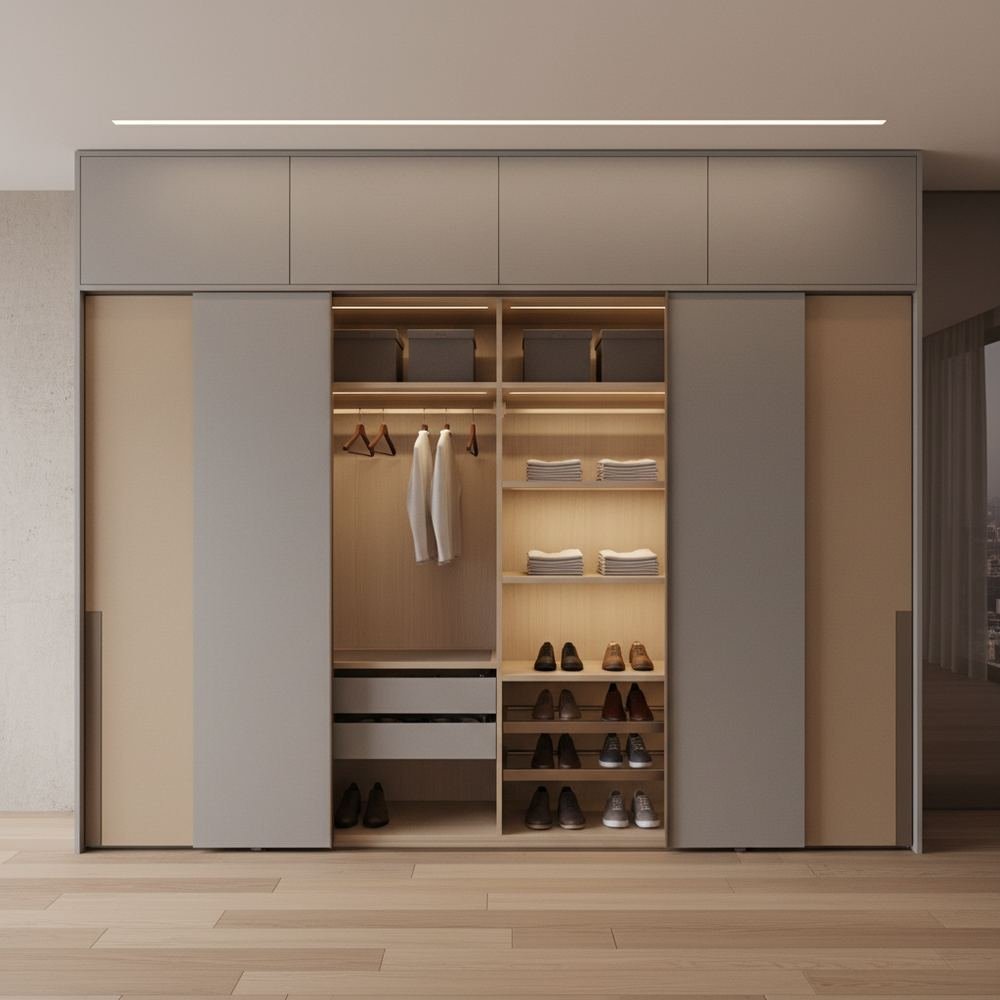
Wardrobe Materials and Finishes: What to Specify and Why
A wardrobe carries more weight for longer than any other joinery in the house, and almost all of it is hidden from view.
A wardrobe carcass should be specified for weight and humidity, and the fronts for finish and appearance. Plywood suits the structure because it holds screws and carries load without sagging, while fibre boards often suit fronts because they are flat and take a better painted finish. As with kitchens, the board and the edge banding matter more than the colour, and they are where quotes are quietly downgraded.
What does a wardrobe actually have to withstand?
Three things, and they are different from a kitchen.
Sustained weight. A full hanging rail carries a lot of load continuously for years. Unlike a kitchen cupboard, that load never comes off. Shelves holding folded clothing carry a steady load across a span.
Humidity cycling. Monsoon humidity and dry heat make boards expand and contract. Over years this loosens joints and lifts edge banding.
Repetition. Doors and drawers are opened every day, often several times, for decades. Hardware sees more cycles here than almost anywhere else in the house.
What a wardrobe generally does not face is direct water, which is the one advantage it has over kitchen and bathroom joinery.
Which board for the carcass?
- Plywood. The sensible default. Its cross grain construction resists sagging under sustained load and it holds screws well, which matters because hinges and rail supports are screwed into it. It also handles humidity cycling better than fibre boards.
- HDF. Dense, stable and holds screws reasonably. Acceptable for a carcass in a dry bedroom, though heavier loaded shelves are better in plywood.
- MDF. Better suited to fronts than to structure. It sags under sustained load across a span and holds screws less reliably.
- Particle board. The cheapest and the first to sag. In a wardrobe, where load is constant rather than intermittent, sagging shelves are the usual outcome.
Shelf thickness and span matter as much as board type. A long shelf in a thin board will bow whatever it is made of, so either use a thicker section or break the span with a division.
Which finish for the fronts?
The same options as a kitchen, with different priorities because a wardrobe faces no heat and no grease.
Laminate is hard wearing, consistent and available in a very wide range. The most practical everyday choice.
Acrylic gives deep gloss and reflects light, which helps a small bedroom, and it shows fingerprints. In a bedroom, where fronts are touched less often than in a kitchen, this is less of a problem than it sounds.
PU lacquer gives any colour with a seamless look and no visible edge banding, which suits a fitted wardrobe intended to read as part of the wall. It is softer and marks more easily.
Veneer gives real grain and warmth, and it should be sequenced across adjacent doors so the grain runs continuously rather than restarting at every joint.
Membrane suits profiled and shaker style fronts, since it wraps a shaped board in one continuous skin. Heat is its weakness, which is rarely an issue in a bedroom.
Are mirrored and glass fronts practical?
Yes, and they do two useful jobs in a Pakistani bedroom: they remove the need for a separate full length mirror, and they make a small room read larger.
The considerations are weight and safety. Mirror and glass are heavy, so hinges and any sliding running gear must be sized for that load. An under specified sliding system with mirrored panels is a system that will run badly within a couple of years.
Mirror should be backed so that if it is broken the pieces are held rather than falling. Ask about this specifically.
Fingerprints are the day to day cost, and handles reduce it because the front gets pulled rather than pushed.
What hardware matters?
- Hinges, because they carry the door for decades and are opened constantly. Soft close should be standard, both for comfort and because slamming loosens fixings over time.
- Drawer channels, especially on drawers that carry weight. Full extension channels make the back of a drawer usable rather than theoretical.
- Sliding running gear, where fitted. This is the component that most determines whether a sliding wardrobe feels good or cheap, and it is worth paying for.
- Rail supports, since a hanging rail carries sustained weight and an under supported rail bows.
- Wall fixings, which must reach solid structure, particularly on a full height fitted unit.
What decides how long it lasts?
The same invisible details as everywhere else. Edge banding thickness, because thin banding lifts in humidity and once lifted the core is exposed. Back panel fit, both for dust and for rigidity. And whether the unit is scribed to the wall, since gaps at the sides and top collect dust and undermine the point of a fitted unit.
None of these appear in a photograph, which is exactly why they are the first things reduced when a quote needs to look competitive.
What should you ask for in writing?
- Which board for the carcass, which for the shutters, and what thickness.
- Shelf thickness and maximum span before a division is added.
- Edge banding thickness.
- Which hinges and channels, and whether soft close is included or extra.
- For sliding, which running gear.
- Whether the unit runs full height and is scribed to the wall.
- What the internal layout actually contains, rail by rail and shelf by shelf.
Having one built
Grains manufactures wardrobes at its own facility on Raiwind Road with imported boards, hinges and channels and soft close hardware as standard, built full height and scribed to the wall, with internals planned around what you actually own. Our own teams install them and return to adjust anything that settles. Measurement, 3D design and a written estimate that names the specification are free. Message WhatsApp +92 320 4443864, or plan the whole room with beds and bedroom designs and see the range on our services page.
Questions, answered.
Plywood is the sensible default, because its cross grain construction resists sagging under the sustained load of a full hanging rail and it holds screws well for hinges and rail supports. HDF is acceptable in a dry bedroom, MDF suits fronts better than structure, and particle board sags first.
Because the board is too thin for the span or too weak for a load that never comes off. Unlike a kitchen cupboard, a wardrobe shelf carries folded clothing continuously for years. Either specify a thicker section or break the span with a vertical division.
Yes, and they remove the need for a separate mirror while making a small bedroom read larger. The considerations are weight and safety: hinges or sliding running gear must be sized for the extra load, and the mirror should be backed so broken pieces are held rather than falling.
Hinges, because they carry the door for decades and are opened constantly, with soft close as standard since slamming loosens fixings. Full extension drawer channels, which make the back of a drawer usable. And sliding running gear, which more than anything determines whether a sliding wardrobe feels good or cheap.
Details you cannot see in a photograph: edge banding thickness, since thin banding lifts in humidity and exposes the core, a properly fitted back panel for both dust and rigidity, and whether the unit is scribed to the wall so no gaps at the sides or top collect dust.
Board for carcass and shutters with thicknesses, shelf thickness and maximum span before a division, edge banding thickness, which hinges and channels and whether soft close is included, which running gear if sliding, whether it runs full height and is scribed to the wall, and the internal layout rail by rail.
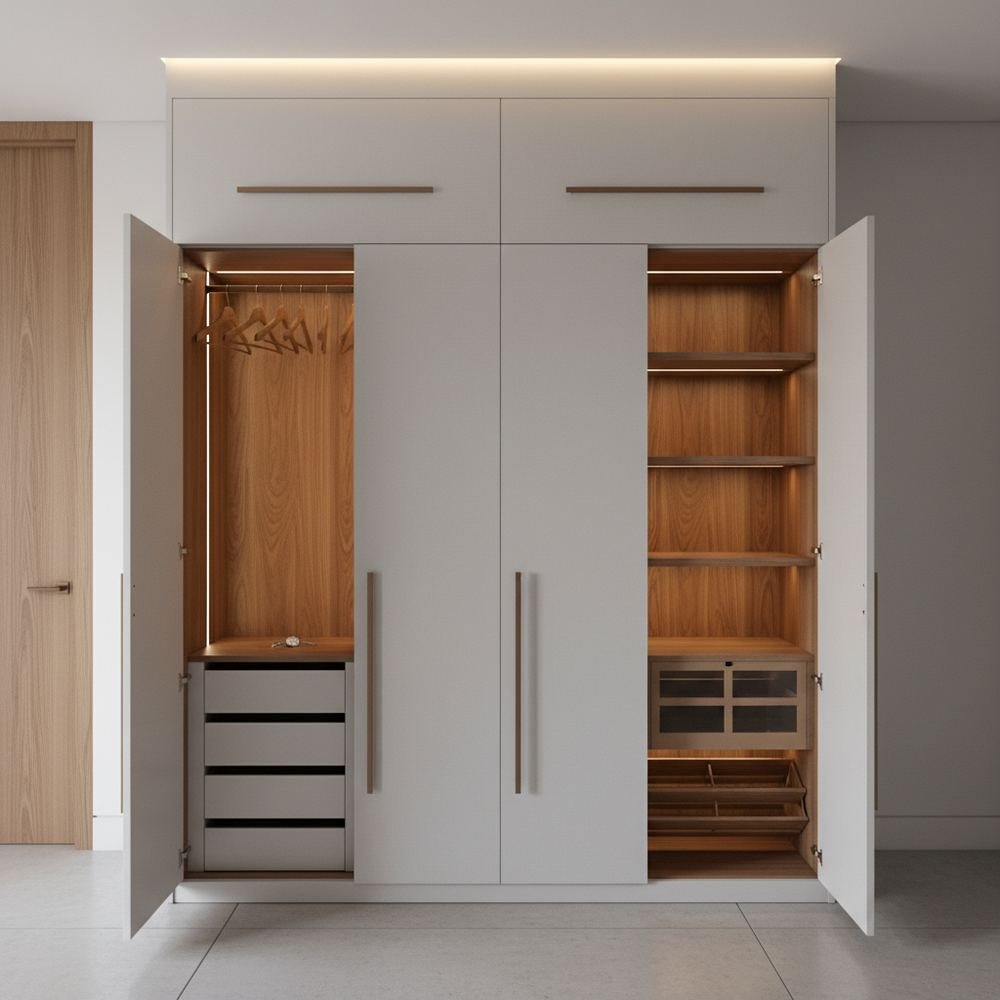
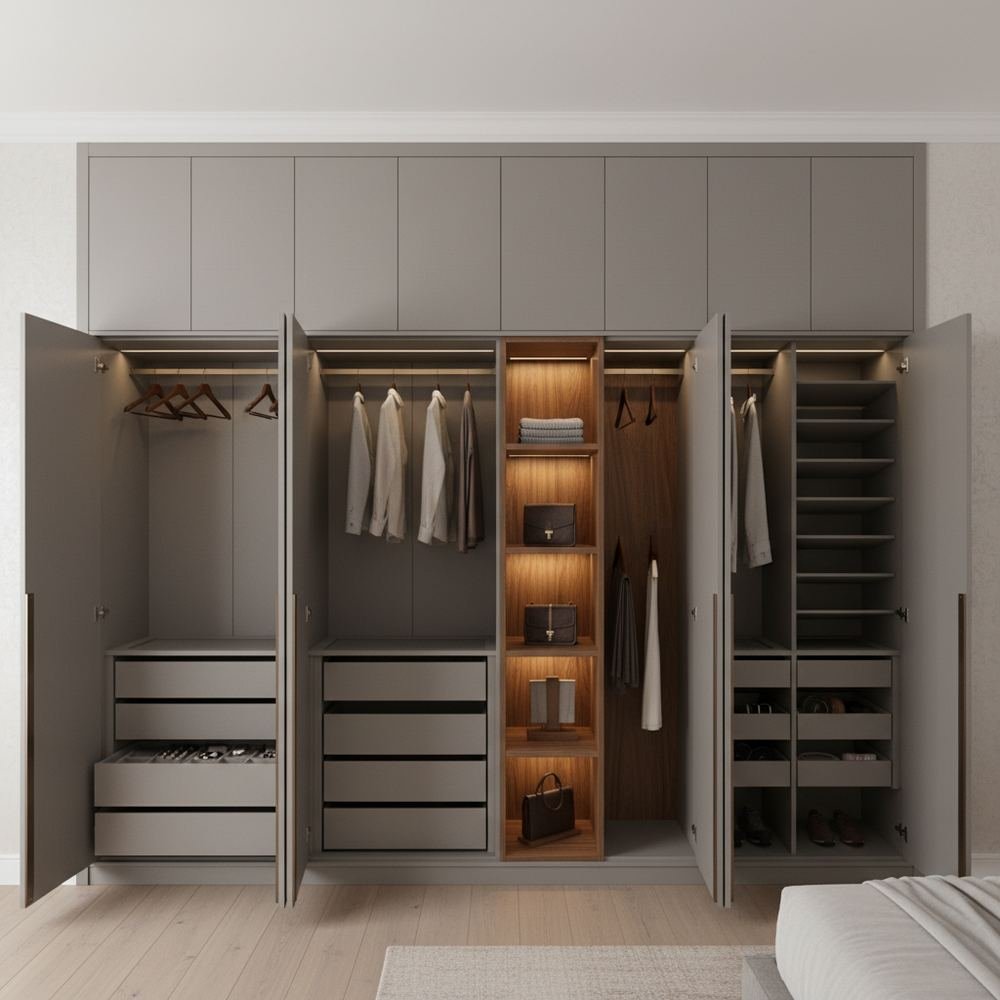
Planning this for your own home?
We measure your space in Lahore free of charge, show you a 3D design before anything is cut, then manufacture and install it with our own teams.