
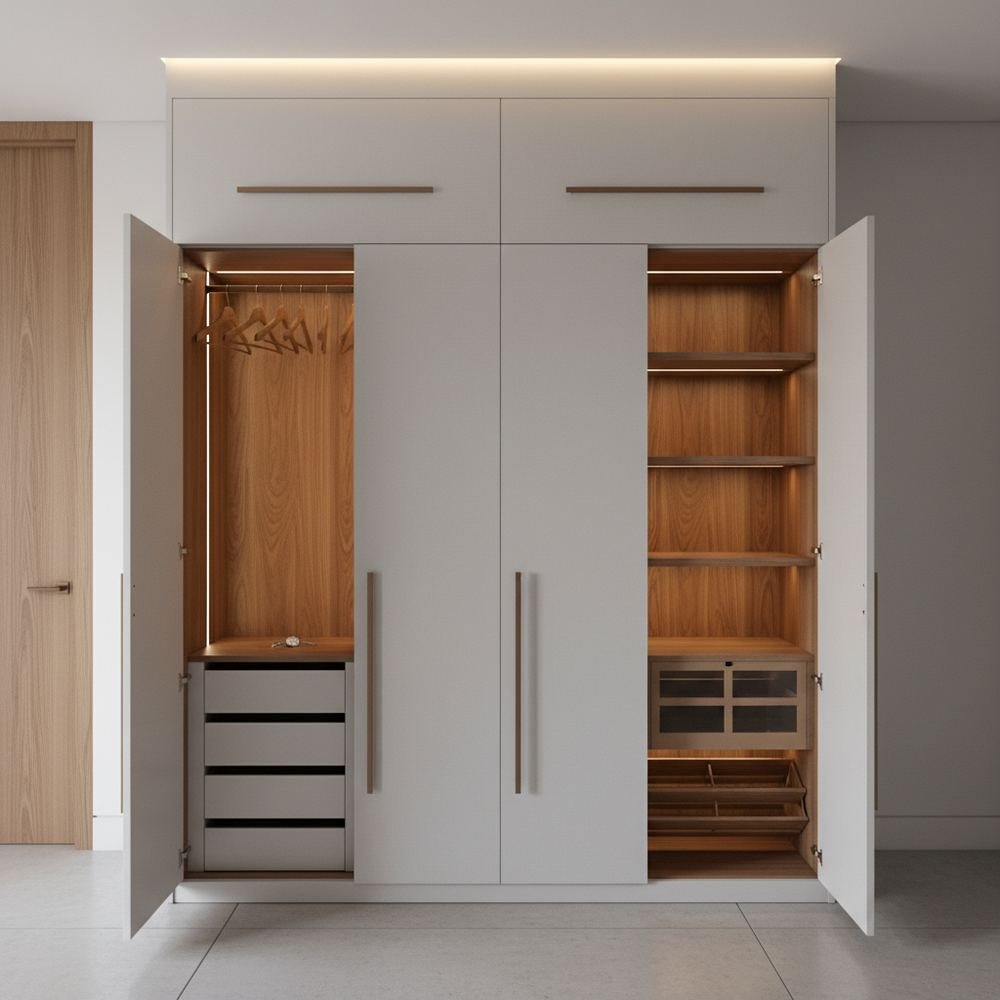
Planning Wardrobe Internals for Shalwar Kameez, Saris and Rezai
A wardrobe built to a standard internal grid will fit shirts and trousers beautifully, and fail at almost everything in a Pakistani wardrobe.
Wardrobe design is usually discussed as an exterior problem. Sliding or swing, how many doors, which finish. Those matter, but they are not what makes a wardrobe good to live with. What decides that is the inside, and the inside is where most wardrobes here go wrong.
The reason is simple. Standard internal layouts come from catalogues built around shirts, trousers and short dresses. That is not what most Pakistani wardrobes hold.
Start with what actually hangs
Before any drawing, count roughly what the wardrobe has to take. The categories behave very differently.
- Shalwar kameez. Longer than a shirt, and usually hung as a set. It needs more vertical clearance than a standard short hanging section allows, and it needs breathing room so the fabric is not crushed.
- Saris and lehngas. These are the ones standard layouts fail worst. They need genuine full length hanging, and heavy formal pieces need space so the embroidery is not pressed flat against everything else.
- Shirts, kurtas and folded items. Short hanging or shelves. This is the only category standard layouts handle well.
- Rezai, quilts and seasonal bedding. Bulky, used for a few months a year, and almost always the thing that ends up in a suitcase on top of the wardrobe because nobody planned for it.
Hanging heights that actually work
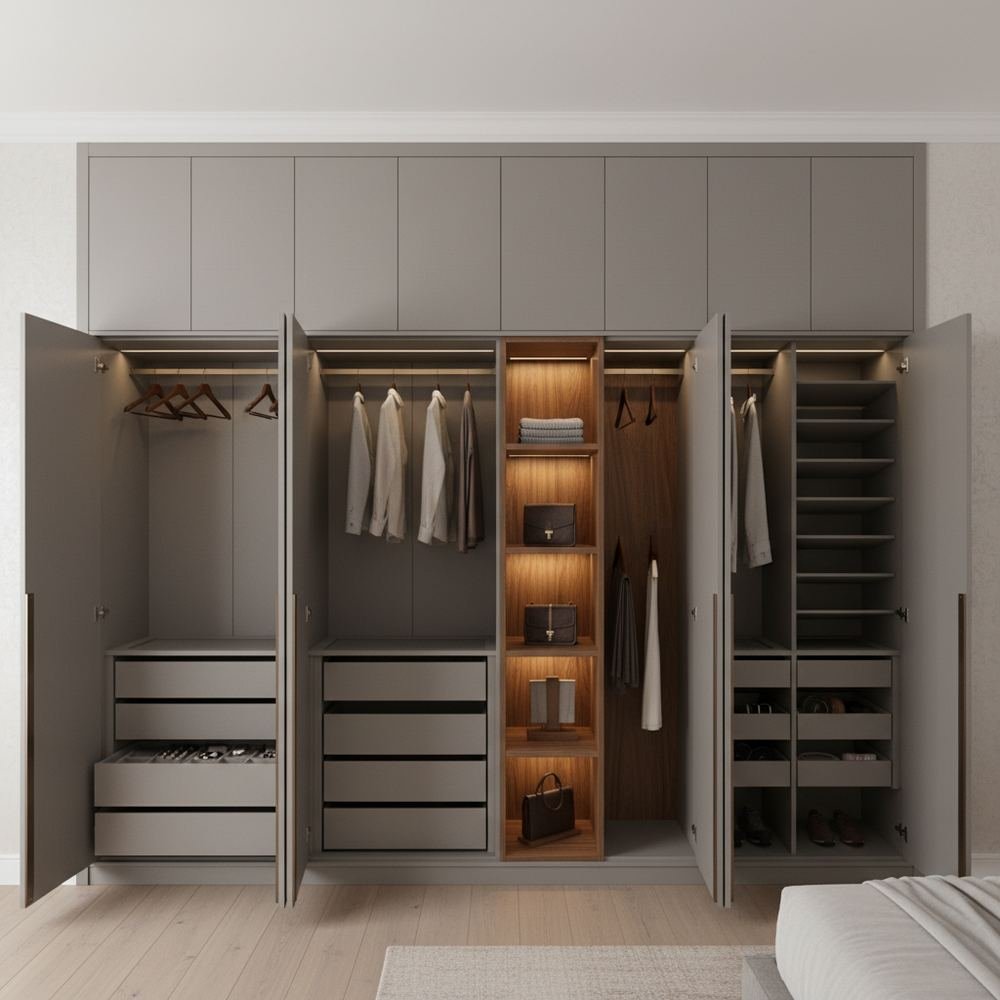
A wardrobe generally wants three hanging zones rather than one.
Full length hanging for saris, lehngas, long coats and formal shalwar kameez. This section needs the tallest clearance in the wardrobe and it is the one people most often make too short.
Medium hanging for everyday shalwar kameez and kurtas. Slightly shorter, and usually the section that gets the heaviest daily use, so it should be the easiest to reach.
Double hanging for shirts and folded trousers, where two rails sit one above the other. This is the most space efficient zone and it is where you claw back the volume the full length section takes.
The proportions between these three should be set by your actual wardrobe, not by a default. Someone who wears mostly formal clothing needs a very different split from someone who does not.
The loft is not an afterthought
Almost every wardrobe in Pakistan needs a loft section, because almost every household has bedding that is only used for part of the year. If it is not designed in, it ends up in bags on top of the wardrobe, which looks untidy and makes the whole thing feel unfinished.
A properly planned loft is deep enough to take a folded rezai, tall enough that it does not have to be crushed to fit, and fitted with doors that match the rest of the wardrobe so the top of the unit reads as part of the design rather than a shelf.
Drawers, and where they should sit
Drawers are more useful than shelves for anything small, because you can see the whole contents at once instead of digging through a stack. They should sit at a comfortable height rather than at the very bottom, where they are awkward to open and easy to forget.
A shallow top drawer for jewellery, watches and small items is worth the space it takes. Fitting it with a soft close runner is worth it too, because that is the drawer opened most often.
Sliding or swing
This is decided by the room, not by preference.
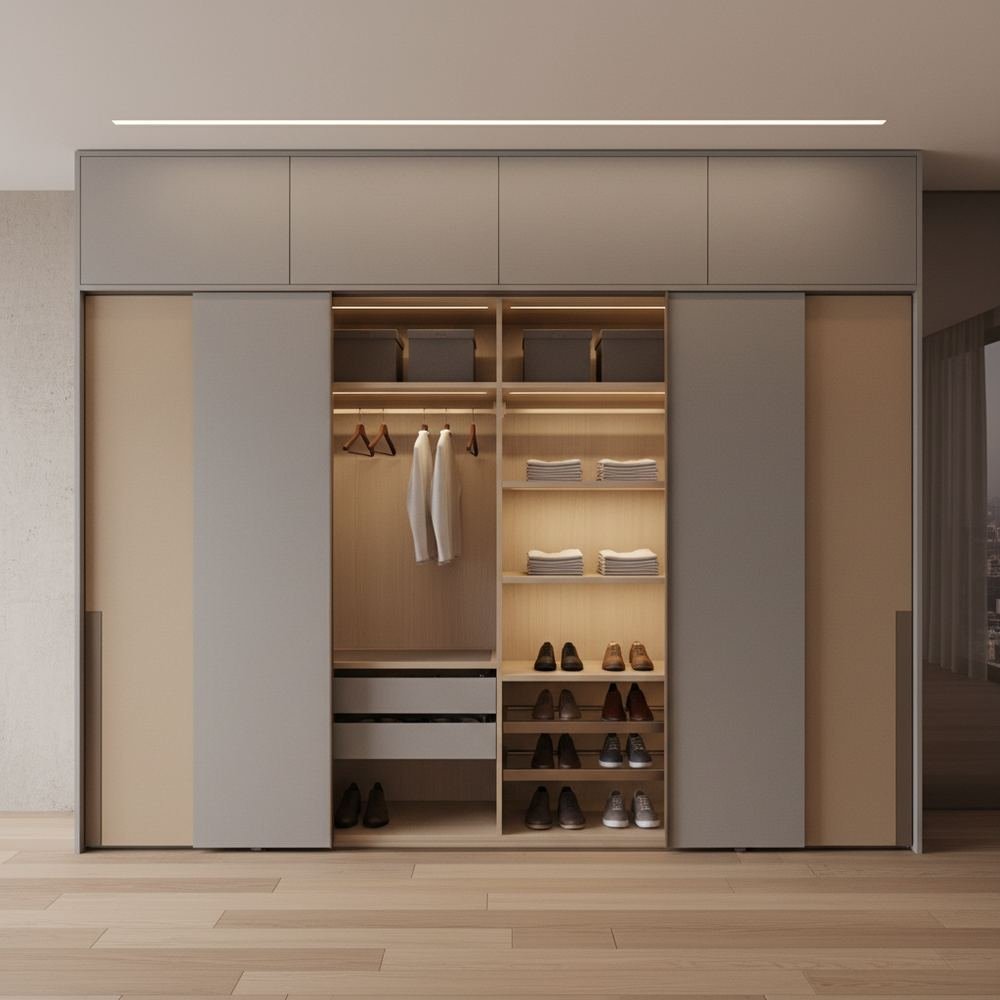
Sliding doors need no clearance in front, so they are the answer when the bed sits close to the wardrobe. The trade off is that you can only ever see half the wardrobe at once, and the track needs occasional cleaning.
Swing doors open the full width so you see everything in one movement, and they seal better against dust. They need clear floor space in front, which not every bedroom has.
Measure the gap between the wardrobe wall and the bed before deciding. If it is tight, the decision is already made.
Mirrors, lighting and dust
A mirrored front saves buying a separate mirror and makes a small bedroom feel larger. Internal lighting is genuinely useful in a deep wardrobe, where the back of a shelf is otherwise in shadow.
Dust deserves a thought too. In most Pakistani cities it is a real factor, and a wardrobe that seals properly keeps clothes cleaner between wears. Swing doors have the advantage here.
Plan it around your clothes
The best wardrobe is not the one with the most features. It is the one whose internal layout matches what you own, so nothing has to be folded when it should hang and nothing lives in a suitcase on top.
When we design a wardrobe we ask what goes into it before we draw it, then set rail heights, shelf positions and the loft around that. We will measure your bedroom in Lahore free of charge and show you the internal layout in 3D before anything is made. Message us on WhatsApp to start.
Questions, answered.
They need a genuine full length hanging section, taller than the standard short hanging zone in most catalogue layouts, and enough room that heavy embroidered pieces are not pressed flat. This is the single most common thing standard wardrobe layouts get wrong in Pakistani homes.
In most Pakistani households, yes. Rezai, quilts and seasonal bedding are bulky and used for only part of the year. If loft storage is not designed in, that bedding usually ends up in bags on top of the wardrobe. A planned loft is deep and tall enough to take folded bedding without crushing it.
It depends on the floor space in front of the wardrobe. Sliding doors need no clearance, so they suit bedrooms where the bed sits close. Swing doors open the full width so you see everything at once and they seal better against dust, but they need clear space in front.
Shelves and rails can sometimes be repositioned if the carcass was built with that in mind, but the overall structure, the loft and the door type are fixed once built. This is why the internal layout is worth deciding carefully before manufacturing rather than after.
Planning this for your own home?
We measure your space in Lahore free of charge, show you a 3D design before anything is cut, then manufacture and install it with our own teams.