
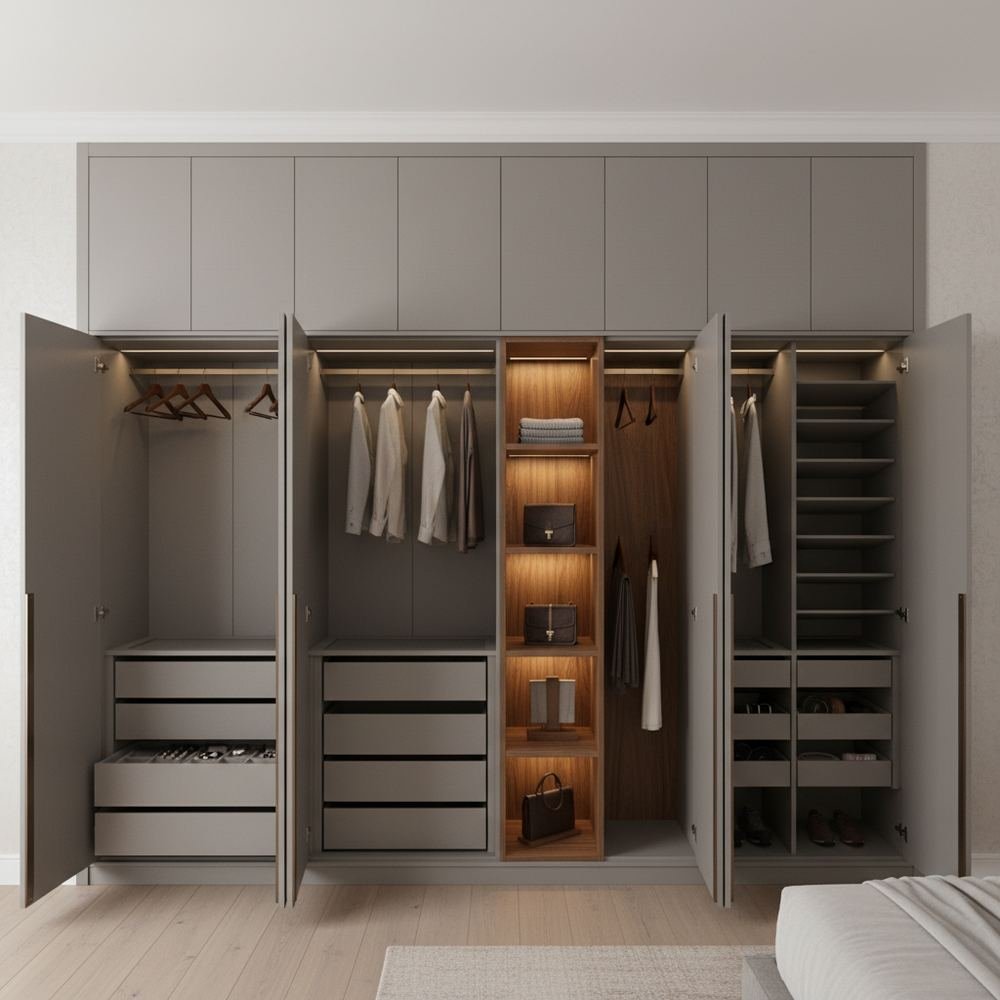
Sliding or Swing Wardrobe Doors: How to Choose for Your Bedroom
This is not a style decision. Measure the gap between your wardrobe wall and your bed, and the answer is usually already made.
Choose sliding wardrobe doors when floor clearance in front of the wardrobe is tight, and swing doors when you have the space for them. Swing doors show you the whole interior at once and seal better against dust, which matters in Pakistani cities. Sliding doors need no clearance at all but hide half the wardrobe at any moment. The room usually decides this before taste does.
How much clearance does each type need?
A swing door needs enough clear floor in front for the door to open fully and for a person to stand there while it is open. If the bed, a dresser or a walkway sits in that arc, the wardrobe becomes awkward to use every single day.
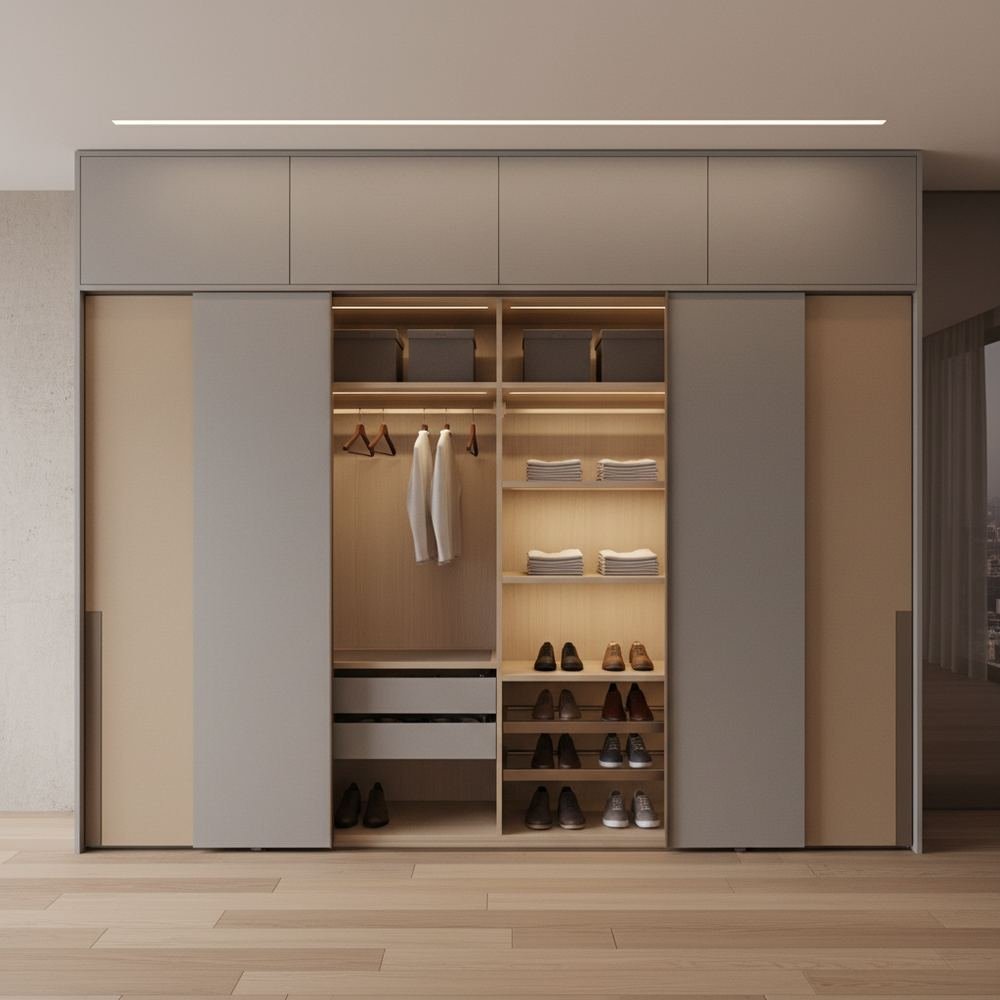
A sliding door needs no clearance in front at all. The panels move across the face of the wardrobe rather than out into the room.
The practical test is simple. Stand where you would stand to get dressed, and imagine a door opening towards you. If you would have to step back or move around the bed, sliding is the answer. In many Pakistani bedrooms, particularly in 5 and 10 marla houses where the wardrobe wall faces the bed closely, that is exactly the situation.
What do you give up with sliding doors?
Three things, and they are worth knowing before you commit.
- You can only ever see part of the wardrobe. With two panels, one half is always covered. Finding something means sliding back and forth.
- You lose some internal depth. The track mechanism occupies space at the front, so the usable depth inside is slightly less than the external depth.
- The track needs cleaning. Dust and grit collect in the bottom track, and a neglected track makes the doors stiff and eventually noisy.
None of these are dealbreakers. They are simply the cost of getting the clearance back.
What do swing doors give you?
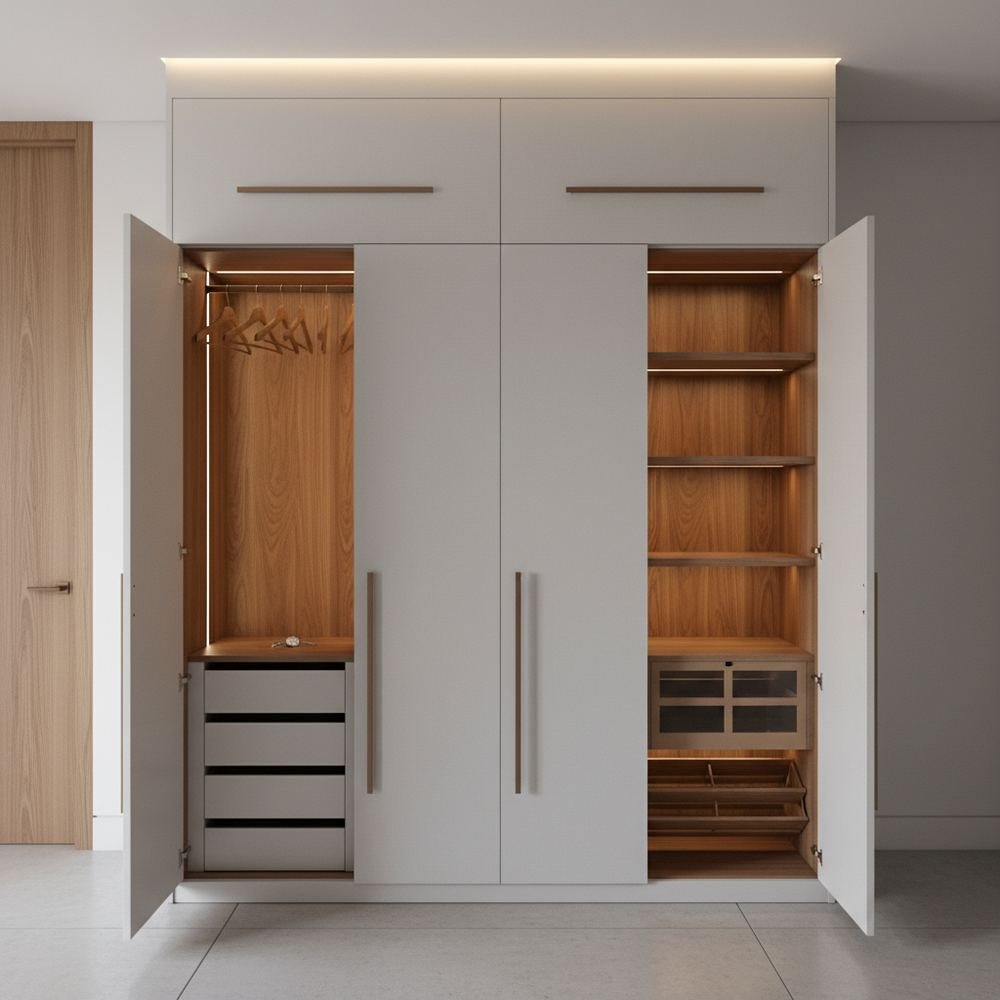
Full visibility in one movement. Open both doors and the entire hanging run is in front of you. For a wardrobe holding shalwar kameez, saris and formal clothing that you browse rather than grab, this is a genuine daily advantage.
Better sealing against dust. This matters more here than most catalogues admit. A swing door closes onto the carcass all the way round, so the interior is close to sealed. A sliding door overlaps rather than seals, and dust gets in around the edges over time. In Lahore that shows up on stored clothes.
Full internal depth. No track mechanism eating into the front.
Simpler mechanics. Hinges are easy to adjust and easy to replace. There is less to go wrong than with a track and roller system.
Which is better for a small bedroom?
Sliding, almost always, and for one reason: the floor space you would have surrendered to a door arc stays usable. In a small room that arc is often the only clear floor you have.
There is a second benefit. A sliding front is a large uninterrupted plane, and if part of it is mirrored it makes a small bedroom read noticeably larger while removing the need for a separate mirror.
The trade off remains that you see half at a time. In a small wardrobe with fewer items, that matters less than it would in a large one.
How does the door type affect the internals?
More than people expect, and this is the part usually discovered too late.
With sliding, the internals should be planned so that the items you reach for daily sit on the side you open most, and so that no drawer or pull out is placed where a panel will block it. A drawer behind a fixed panel position is a permanent irritation.
With swing, the internals can run continuously across the full width, because the entire face opens. This makes long hanging runs for saris and lehngas easier to lay out sensibly.
Either way the internals should be decided before the doors are, not after. Rail heights, the loft section for rezai and seasonal bedding, and drawer positions are what you live with every morning.
Which costs more?
It depends on specification more than on type. A basic sliding system and a basic hinged wardrobe are not far apart. The cost drivers are the same in both cases: board grade, front material and finish, whether mirror or glass is included, the quality of the running gear or hinges, and how much internal fitting you specify.
Where sliding can pull ahead on cost is in the running gear. Good rollers and a well made track are worth paying for, because a cheap sliding system is the version people complain about. If the budget forces a compromise, a well built swing wardrobe usually beats a poorly built sliding one.
A short decision rule
- Measure the clear floor between the wardrobe wall and the nearest obstacle.
- If that space is tight, choose sliding. The decision is made.
- If the space is comfortable, ask whether dust and full visibility matter more than the look of a large uninterrupted front. If yes, choose swing.
- If you want a full length mirror without buying one, and the room is small, that pushes towards sliding.
- If the budget is tight, prefer a well built swing over a cheap sliding system.
Can you combine them?
Yes, and on a long wall it often works well. A sliding section can face the bed where clearance is tight, while a swing section at the end, where the floor is clear, gives full access to the long hanging run. Corner and loft sections can also be hinged even when the main run slides.
This only works if it is planned at design stage, because the two systems need different carcass detailing at the point where they meet.
Getting yours planned
Grains measures your bedroom in Lahore, checks the clearances properly, and shows you the wardrobe in 3D before anything is cut, so you can see how the doors behave in your actual room. Everything is made at our own facility on Raiwind Road with imported boards, hinges and channels and soft close hardware as standard, and installed by our own teams. Measurement, design and estimate are free. Message WhatsApp +92 320 4443864. If the bedroom is part of a larger project, see the full services page or browse beds and bedroom designs.
Questions, answered.
Measure the clear floor between the wardrobe wall and the nearest obstacle such as the bed. If that space is tight, choose sliding, because sliding panels need no clearance in front. If the floor is comfortably clear, swing doors are usually better because they show the whole interior at once and seal better against dust.
Less effectively than swing doors. A swing door closes onto the carcass all the way round, so the interior is close to sealed. Sliding panels overlap rather than seal, so dust works in around the edges over time. In Lahore and similar cities this shows up on stored clothing.
Slightly. The track and roller mechanism occupies space at the front of the carcass, so usable internal depth is a little less than the external depth. You also see only half the wardrobe at a time, which affects how you organise it rather than how much it holds.
Sliding, in almost every case, because the floor a swing door would need for its arc stays usable. A sliding front is also a large uninterrupted plane, so mirroring part of it makes the room read larger and removes the need for a separate mirror.
Not inherently. Cost is driven mainly by board grade, front material and finish, mirror or glass, hardware quality and how much internal fitting you specify. Sliding can cost more if you specify good running gear, which is worth doing, because a cheap sliding system is the version people regret.
Yes, and on a long wall it often works well. A sliding section can face the bed where clearance is tight while a hinged section at the clear end gives full access to long hanging. It has to be planned at design stage because the two systems need different carcass detailing where they meet.
Planning this for your own home?
We measure your space in Lahore free of charge, show you a 3D design before anything is cut, then manufacture and install it with our own teams.