
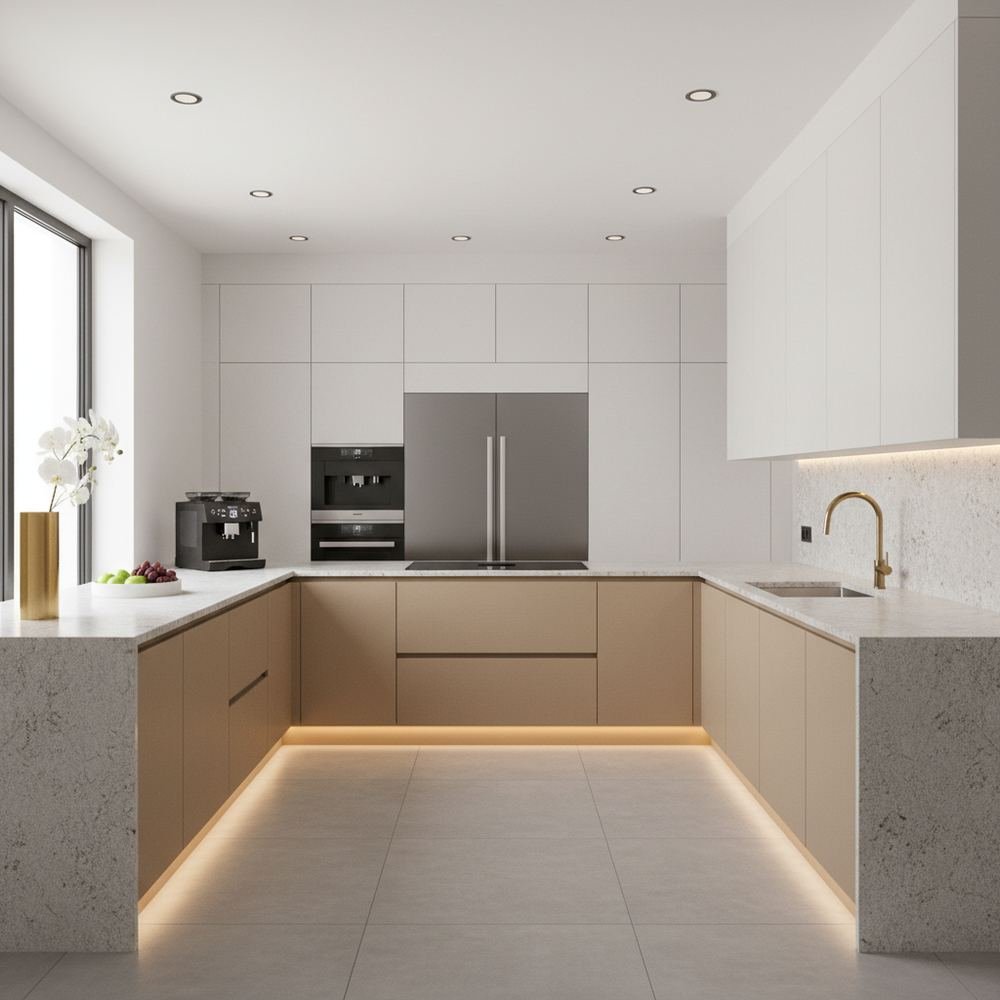
How to Choose a Kitchen Chimney That Handles Pakistani Cooking
Desi cooking puts more grease into the air in one tarka than a week of light cooking. Most chimney advice ignores that completely.
A kitchen chimney for a Pakistani kitchen needs three things: enough suction for high heat frying, a filter type that copes with heavy grease, and ducting that actually vents outside. Get any one of those wrong and the chimney becomes an expensive fan that moves smell around the room. The specifications printed on the box are written for kitchens that do far less frying than ours.
Why does desi cooking need a different chimney?
The difference is grease and heat, not smoke. A tarka releases oil into the air as fine aerosol, not just vapour. That aerosol condenses on every cool surface it reaches, which is why kitchen ceilings and upper cabinet fronts go sticky over time even when the room looks clean.
Frying pooris, making karahi and cooking on high flame all produce this. Light cooking such as boiling and baking produces steam, which a modest chimney handles easily. Almost all chimney marketing is built around the second case.
The practical consequence is that a chimney which is adequate on paper often underperforms badly in a Pakistani kitchen, and the owner concludes chimneys do not work.
How much suction do you actually need?
Suction is quoted as air volume moved per hour. Rather than chasing a number, reason from your room and your cooking.
- Room volume matters. A larger or higher kitchen needs more air moved to clear it in the same time.
- Enclosure matters. A closed kitchen holds grease in and needs more extraction than an open plan one that dilutes it, though an open plan kitchen spreads smell into the living area, which is its own problem.
- Cooking style matters most. Daily deep frying and high flame cooking demand meaningfully more than occasional light use.
- Duct length and bends matter. Every metre of duct and every bend reduces effective performance, so a chimney far from an outside wall needs more headroom in its rating.
Choose more suction if you fry several times a week, your kitchen is enclosed, or the duct run to the outside wall is long or has bends. Modest suction is fine if your kitchen is open, cooking is mostly light, and the chimney sits close to an external wall.
Which filter type suits a Pakistani kitchen?
Filters are where most of the long term frustration lives.
Baffle filters use curved metal plates that force air to change direction sharply, throwing grease out of the airflow. They cope well with heavy oil, keep working as they load up, and can be removed and washed. For most Pakistani kitchens this is the sensible default.
Mesh filters use layered metal netting. They trap grease effectively at first, then clog. Once clogged, suction drops sharply and cleaning them properly is tedious. In a kitchen that fries regularly they need attention far more often than people expect.
Filterless designs use centrifugal force to fling oil into a collector. They reduce cleaning to emptying a cup, which is genuinely convenient, but the internal surfaces still need periodic cleaning and a neglected unit loses performance quietly.
Whatever the type, assume cleaning is a regular chore in a Pakistani kitchen rather than an annual one.
Ducted or recirculating?
A ducted chimney pushes air outside. A recirculating one passes air through a charcoal filter and returns it to the room.
For our cooking, ducted is the right answer wherever it is physically possible. Recirculation removes some smell but leaves heat and moisture in the kitchen, and the charcoal filters need replacing on a schedule most households forget.
Ducting works best when the run is short, straight and gently sloped. Long horizontal runs with several bends lose performance and collect grease inside the duct itself. This is why chimney position should be decided at kitchen design stage, when the layout can still be arranged so the hob sits near an external wall.
Where should the chimney sit?
Mounting height is the detail most often botched. Too high and the chimney cannot capture the plume before it spreads. Too low and it is uncomfortable to cook under and risks heat damage.
The right height depends on the unit and the person cooking, so it should be set on site rather than fixed to a standard. If several people of different heights cook, set it for the person who cooks most.
The chimney should also be wider than the hob, or at least equal to it. A chimney narrower than the cooking surface will always miss the plume from the outer burners, which is a common and avoidable mistake.
What else affects how well it works?
- Make up air. A chimney can only pull air out if air can get in. In a tightly closed kitchen, extraction fights a vacuum and performance falls. Leaving a window or door slightly open while cooking makes a noticeable difference.
- Surrounding cabinetry. Upper cabinets directly beside the hob catch grease. Planning a gap or a wipeable surface there saves years of scrubbing.
- Power supply. The point should be planned during electrical first fix so no cable is visible afterwards.
- Noise. Higher extraction generally means more noise. If the kitchen opens onto a living space, this is worth considering before buying.
How does this affect the kitchen design?
The chimney is not an accessory bought after the kitchen is fitted. It changes the design. It decides where the hob can sit, whether an island is realistic, how the upper cabinets are arranged around it, and where a duct route has to be left.
Deciding it late is why so many kitchens end up with a duct boxed in awkwardly across a wall, or a chimney positioned where it looks tidy rather than where it works. When we plan a kitchen, extraction is settled at layout stage along with the sink and hob positions, because moving it later means moving cabinetry.
It also interacts with ceiling design. A false ceiling can conceal a duct run elegantly, but only if the route is known before the ceiling is built.
Planning yours
Grains has been building kitchens in Pakistan for over 65 years, and every kitchen we make is manufactured at our own facility on Raiwind Road and installed by our own teams. When we measure your kitchen we plan the extraction route, the hob position and the cabinetry around them together, so the chimney works rather than merely fits. The measurement visit, the 3D design and the estimate are free. Message us on WhatsApp at +92 320 4443864 with your kitchen size, or see the full range on our services page.
Questions, answered.
There is no single figure, because it depends on room volume, whether the kitchen is open or enclosed, how often you fry, and the length and number of bends in the duct run. Choose higher suction if you fry several times a week, the kitchen is closed, or the duct route to an external wall is long or bent.
Baffle filters suit Pakistani kitchens better. They force air to change direction sharply so grease drops out of the airflow, they keep working as they load, and they wash easily. Mesh filters trap grease well initially but clog, after which suction falls noticeably and cleaning becomes tedious.
Ducted, wherever it is physically possible. Ducting removes heat, moisture, smell and grease from the kitchen entirely. Recirculating units pass air through charcoal filters and return it to the room, which removes some smell but leaves heat and humidity, and the filters need replacing on a schedule most households forget.
It depends on the unit and the height of whoever cooks most, so it should be set on site rather than to a fixed standard. Too high and it cannot capture the plume before it spreads, too low and it is uncomfortable and risks heat damage. The chimney should also be at least as wide as the hob.
The most common causes are a clogged filter, a long or bent duct run, a chimney narrower than the hob, mounting height set wrong, or no make up air. A chimney can only pull air out if air can get in, so in a tightly sealed kitchen extraction fights a vacuum and performance drops.
At layout stage, alongside the sink and hob positions. Extraction determines where the hob can sit, whether an island is realistic, how upper cabinets are arranged and where the duct route runs. Deciding it after the kitchen is built usually means a duct boxed in awkwardly or a chimney placed where it looks tidy rather than where it works.
Planning this for your own home?
We measure your space in Lahore free of charge, show you a 3D design before anything is cut, then manufacture and install it with our own teams.