
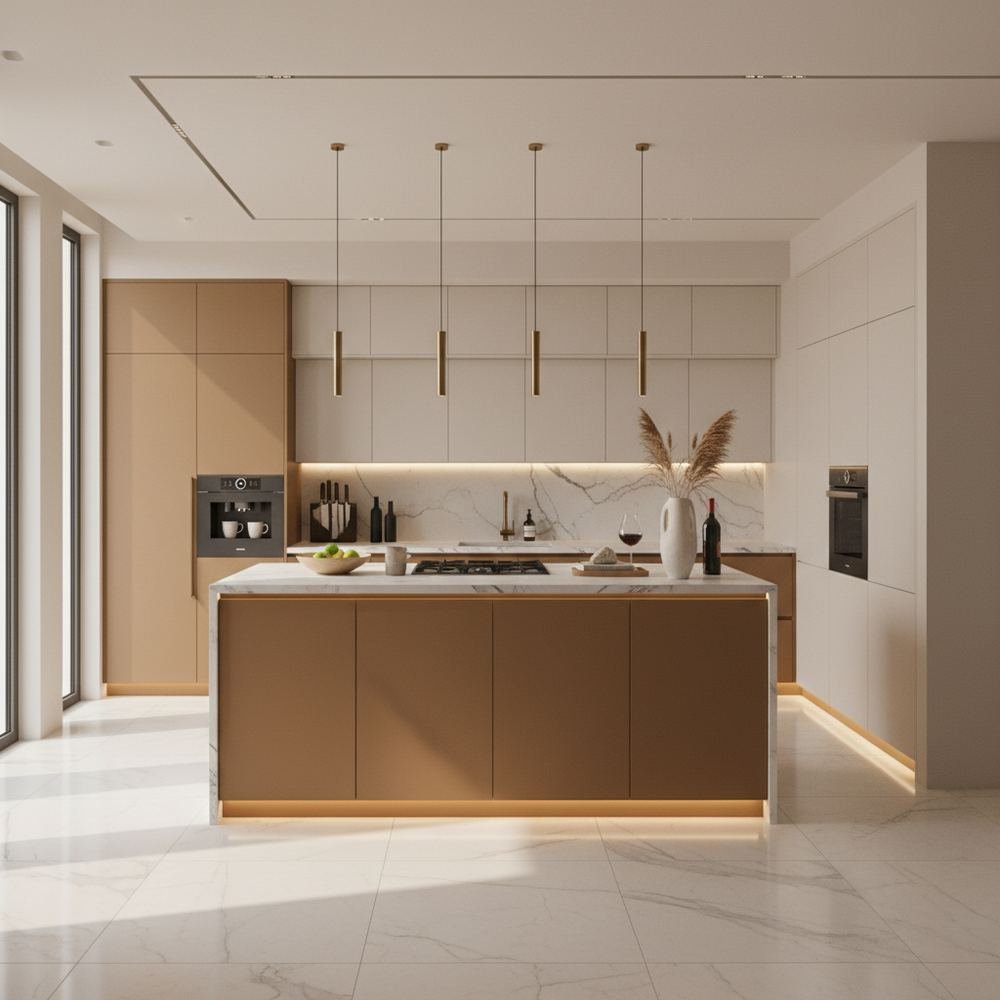
Updating a Kitchen Without Tearing the Whole Thing Out
If the carcasses are sound and the layout works, most of what you dislike about your kitchen can be changed without touching the plumbing.
You can usually update a kitchen without a full rebuild if two things are true: the carcasses are structurally sound and the layout works for how you cook. If both hold, replacing shutters, the worktop, hardware and lighting transforms the kitchen at a fraction of the cost and disruption. If either fails, a partial update is money spent on a kitchen you will still want to replace.
How do you tell whether the carcasses are worth keeping?
Open every cabinet and check five things.
- The cabinet under the sink. Look with a torch at the base and the back. Swelling, softness, staining or a musty smell means water has been getting in, and that carcass is finished regardless of how the rest look.
- Squareness. Do the cabinets still sit square, or have they racked so that doors no longer align? Racking means the carcass has lost rigidity.
- Shelf sag. Bowed shelves indicate a board that was too thin or too weak for the span, and the same board is elsewhere in the cabinet.
- Edges. Lifted or missing edge banding, especially near the sink and dishwasher, means exposed core.
- Screw fixings. Do hinges hold firm, or do the screws turn without biting? Stripped fixings in a soft board cannot be reliably repaired.
If the carcasses pass, a facelift is genuinely viable. If several fail, particularly under the sink, replacement is the honest answer.
Is your layout actually the problem?
This is the question people skip, and it decides everything.
If your complaint is that the kitchen looks dated, a facelift solves it. If your complaint is that there is nowhere to prepare food, that two people cannot work at once, that the fridge is in the wrong place, or that you walk too far between the sink and the hob, then the layout is wrong and new shutters will not fix it.
Be honest here. A beautifully refinished kitchen with the same frustrating layout is a common and expensive disappointment. If the layout is the issue, the plumbing and electrical positions have to move, and at that point you are doing a full renovation.
What gives the biggest visual change for the least money?
- Shutters and drawer fronts. These are most of what you see. Replacing them changes the kitchen completely while the carcasses stay in place.
- The worktop. The largest continuous surface in the room and a major part of the impression it gives.
- Handles. The cheapest meaningful change available, and quick.
- Lighting, especially under cabinet. This changes how the kitchen feels to work in more than almost anything else, because it removes the shadow you cast on your own worktop.
- The splashback. A defined area with high visual impact for a modest quantity of material.
- The sink and tap. Used constantly and often the most worn items in the room.
What is worth upgrading while everything is open?
Some things are cheap to do during a renovation and expensive to do separately. If the kitchen is already disrupted, consider:
Hardware. Replacing hinges and channels with soft close while the shutters are off costs little extra in labour and changes how the kitchen feels every day.
Internal fittings. Converting a base cupboard to deep drawers, or adding a corner solution, is far easier when the shutters are already off.
Sockets. If the splashback is coming off anyway, adding worktop points is comparatively simple. Doing it later means removing a finished splashback.
Extraction. If the chimney is being replaced, review whether it actually vents outside and whether the duct run is sensible.
In what order should the work happen?
Sequence matters even in a partial renovation, because doing it wrong means paying twice.
- Decide the full scope first, including anything you might defer, so nothing is built in a way that blocks a later stage.
- Any electrical or plumbing changes.
- Splashback and wall finishes behind the units.
- Carcass repairs or replacements.
- New shutters and hardware.
- Worktop, templated after the cabinets are set.
- Sink, tap and appliances.
- Lighting and final adjustment.
The worktop must be templated after the cabinets are final, never before. This is the most common sequencing mistake in kitchen renovations.
Can you replace shutters on any kitchen?
Usually, but not always, and it is worth checking before planning around it.
New shutters need the existing carcass to be a standard, workable size, the hinge positions to be usable or re drillable into sound material, and the carcass fronts to be square enough that new doors will align.
Where a kitchen was site built to no particular standard, every cabinet may be a slightly different size. That is not a barrier if the new shutters are made to order and each one is measured individually, which is exactly what a made to order manufacturer does anyway. It does mean the measurement stage matters more than usual.
When is a full replacement the better answer?
When the layout does not work, when the sink cabinet has water damage, when several carcasses have lost rigidity, or when the sum of the partial upgrades approaches the cost of a new kitchen.
That last point deserves attention. Shutters plus worktop plus hardware plus internal fittings plus lighting can add up quickly. Price both options before committing, because a partial renovation that costs nearly as much as a full one, and leaves you with the original layout and carcasses, is the worst outcome available.
Getting an honest assessment
Grains will look at your existing kitchen, tell you plainly whether the carcasses are worth keeping, and price both a facelift and a replacement so you can compare them properly rather than guess. Everything we make is manufactured at our own facility on Raiwind Road with imported boards, hinges and channels, and installed by our own teams. The visit, the 3D design and the estimate are free. Message WhatsApp +92 320 4443864, or see the range on our services page.
Questions, answered.
Yes, if the carcasses are structurally sound and the layout works for how you cook. Replacing shutters, worktop, hardware and lighting transforms a kitchen at a fraction of the cost. If the sink cabinet has water damage or the layout is the real problem, a partial update is money badly spent.
Check five things: the cabinet under the sink for swelling, softness or musty smell, whether cabinets still sit square, whether shelves have sagged, whether edge banding has lifted near water, and whether hinge screws still bite or turn freely in stripped holes. Failure under the sink is decisive.
Shutters and drawer fronts, since they are most of what you see. Then the worktop as the largest continuous surface, handles as the cheapest meaningful change, and under cabinet lighting, which changes how the kitchen feels to work in by removing the shadow you cast on your own worktop.
Decide the full scope first, then electrical and plumbing changes, splashback and wall finishes, carcass repairs, new shutters and hardware, then the worktop templated after cabinets are set, then sink, tap and appliances, then lighting. Templating the worktop before the cabinets are final is the most common mistake.
When the layout does not work, when the sink cabinet is water damaged, when several carcasses have lost rigidity, or when the partial upgrades add up to nearly the cost of a new kitchen. Price both before committing, since a facelift costing almost as much as a replacement is the worst outcome.
Usually. The carcass needs to be sound, hinge positions usable or re drillable into solid material, and fronts square enough for new doors to align. Site built kitchens often have cabinets of slightly differing sizes, which is fine when shutters are made to order and each is measured individually.
Planning this for your own home?
We measure your space in Lahore free of charge, show you a 3D design before anything is cut, then manufacture and install it with our own teams.