
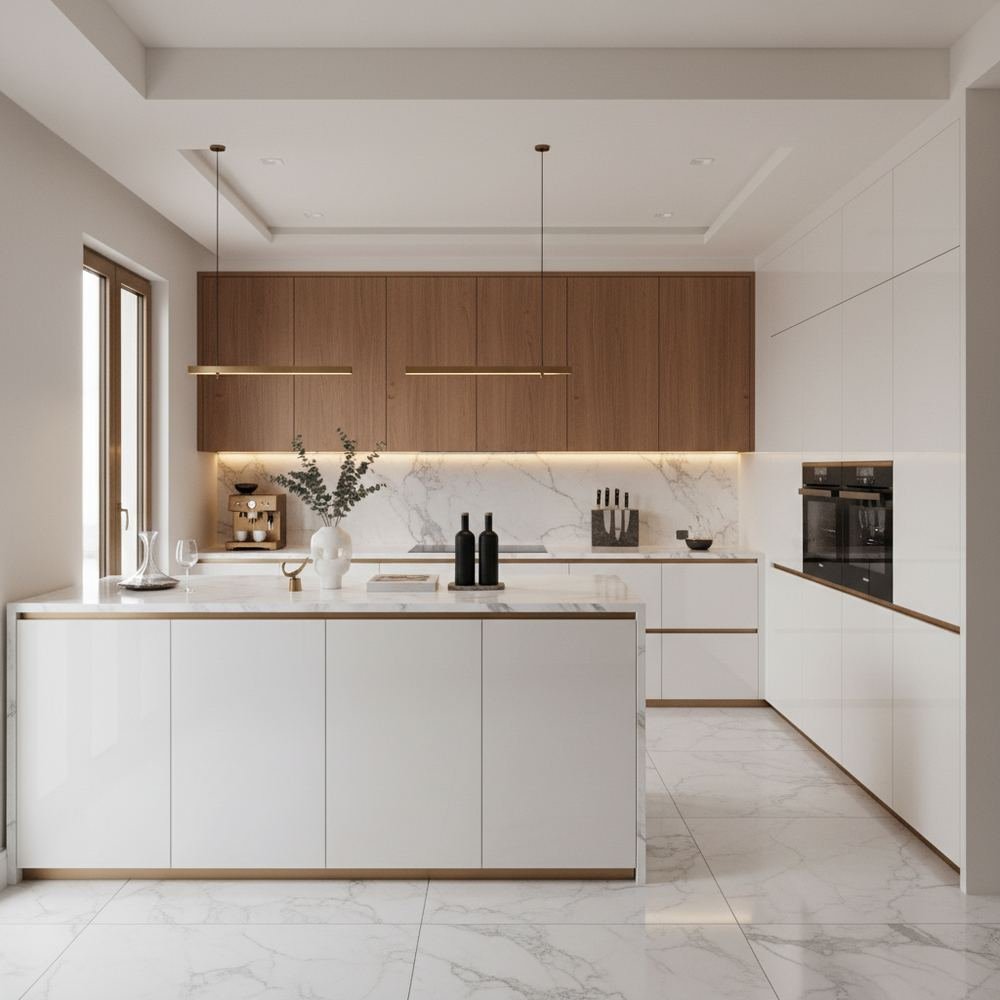
Kitchen Lighting: Why You Are Working in Your Own Shadow
If you chop vegetables in your own shadow, the problem is not brightness. It is that the light is behind you.
Most kitchens are lit by a single ceiling fixture, which means whenever you stand at the worktop your body blocks the light and you work in your own shadow. The fix is not a brighter ceiling light. It is task lighting mounted under the upper cabinets, throwing light onto the surface from in front of you. That one change improves a kitchen more than almost any other lighting decision.
Why does a ceiling light leave you in shadow?
Because of where you stand. A ceiling fixture is in the middle of the room. The worktop is against the wall. When you face the worktop, the light source is behind you, and your body blocks it.
Making that light brighter does not help, because the shadow is caused by position rather than intensity. It simply produces a brighter room with the same dark worktop.
This effect is strongest in small kitchens, where you are closer to both the light and the wall, which is exactly where good visibility matters most because there is less spare worktop to work around.
What are the three layers a kitchen needs?
- Task lighting. Light directly on the working surfaces. Under cabinet lighting for the worktop, and something over the hob and sink, which are usually the two busiest points and often the worst lit.
- Ambient lighting. General light so the room is not a series of bright pools in a dark space. This is what the ceiling fixture should be doing, rather than trying to do everything.
- Accent lighting. Light inside glazed units, on open shelving, or washing a splashback. Not necessary, but it is what makes a kitchen look finished in the evening.
The failure in most kitchens is having only the second layer and expecting it to do the first.
How should under cabinet lighting be done?
Mounted towards the front edge of the upper cabinet rather than at the back. Placed at the back, the light hits the splashback and reflects, which produces glare rather than useful illumination on the worktop.
A continuous strip gives even light along the whole run. Individual spots create bright pools with darker gaps between them, which is workable but noticeably less good.
It should be on its own switch. Under cabinet lighting is also the ideal low level light for the kitchen at night, and that only works if it can be used without turning on everything else.
All of this must be wired during the fit out. Retrofitting means either a visible cable or removing cabinets, so it belongs in the kitchen design conversation and in electrical first fix.
What about the hob and the sink?
Both need dedicated light and both are frequently overlooked.
Most extraction units include a light, and whether it is adequate varies a great deal. Check it rather than assuming, because the hob is where you most need to judge colour and doneness.
The sink is usually against a wall with no cabinet above it, so under cabinet lighting does not reach it. If there is a window there, daylight covers it during the day and nothing covers it at night. A dedicated fitting above the sink solves a problem most people simply live with.
What colour of light suits a kitchen?
Neutral to slightly warm generally works best. Light that is too cool feels clinical, while light that is too warm makes it difficult to judge the colour of food, which matters when you are cooking.
Consistency matters more than the precise choice. Mixing warm under cabinet lighting with cool ceiling lighting looks wrong even to people who cannot explain why, and it also makes your worktop and cabinet colours read differently in different parts of the room.
Colour quality is worth attention too. Poor quality light makes food, timber and stone all read badly, which undermines the finishes you chose carefully.
Does lighting depend on the finish?
Yes, more than most people expect.
Gloss fronts reflect light, which brightens a kitchen but also reflects the light source itself. A poorly placed fitting will appear as a bright reflection in the cabinet doors.
Matte fronts absorb more light, so a matte dark kitchen needs more light than a gloss pale one to achieve the same working brightness.
Dark worktops absorb a great deal of light. A dark granite or quartz surface makes task lighting more important, not less.
If you are choosing dark finishes, plan the lighting alongside them rather than afterwards.
What about a false ceiling?
A false ceiling in a kitchen is useful mainly for two things: concealing chimney ducting, and carrying recessed lighting positioned where you actually want it rather than where the existing point happens to be.
If you are fitting one, position the recessed lights above the front edge of the worktop rather than in the centre of the room. Lights placed forward of where you stand reduce the shadow problem considerably, even before under cabinet lighting is added.
Switching must be settled before the ceiling is closed, because lighting positioned but not separately switched is the most common regret afterwards.
A simple checklist
- Under cabinet lighting along every worktop run, mounted at the front.
- A dedicated light at the sink.
- A working light over the hob, checked rather than assumed.
- Ambient ceiling light on a separate switch.
- Recessed lights positioned forward of where you stand, not centrally.
- Consistent colour temperature throughout.
- Everything wired during the fit out.
Planning it properly
Grains plans kitchen lighting with the cabinet layout rather than after it, so under cabinet wiring, switch positions and any ceiling work are settled before anything is manufactured at our facility on Raiwind Road. Our own teams install both. Measurement, 3D design and a written estimate are free. Message WhatsApp +92 320 4443864, or see the range on our services page.
Questions, answered.
Because the only light is on the ceiling behind you. When you face the worktop against the wall, your body blocks that light. A brighter ceiling fixture does not fix it, since the shadow is caused by position rather than intensity. Under cabinet lighting throws light onto the surface from in front instead.
Towards the front edge of the upper cabinet, not at the back. Mounted at the back it hits the splashback and reflects, creating glare rather than useful light on the worktop. A continuous strip gives even coverage, while individual spots leave bright pools with darker gaps.
Task lighting directly on working surfaces, ambient lighting so the room is not bright pools in a dark space, and accent lighting inside glazed units or washing a splashback. Most kitchens have only ambient light and expect it to do the task job, which is why they feel poorly lit.
Neutral to slightly warm. Too cool feels clinical, too warm makes it hard to judge the colour of food while cooking. Consistency matters more than the exact figure, since mixing warm under cabinet light with cool ceiling light looks wrong and makes finishes read differently around the room.
Yes. Matte and dark surfaces absorb light rather than reflecting it, so a dark matte kitchen needs more light than a pale gloss one to reach the same working brightness. Dark granite or quartz worktops absorb a great deal, which makes task lighting more important rather than less.
Not easily. Under cabinet lighting retrofitted after the kitchen is fitted means either a visible cable or removing cabinets to route it. Ceiling lighting added after a false ceiling is closed means opening and patching it. Lighting belongs in the kitchen design and electrical first fix conversation.
Planning this for your own home?
We measure your space in Lahore free of charge, show you a 3D design before anything is cut, then manufacture and install it with our own teams.