
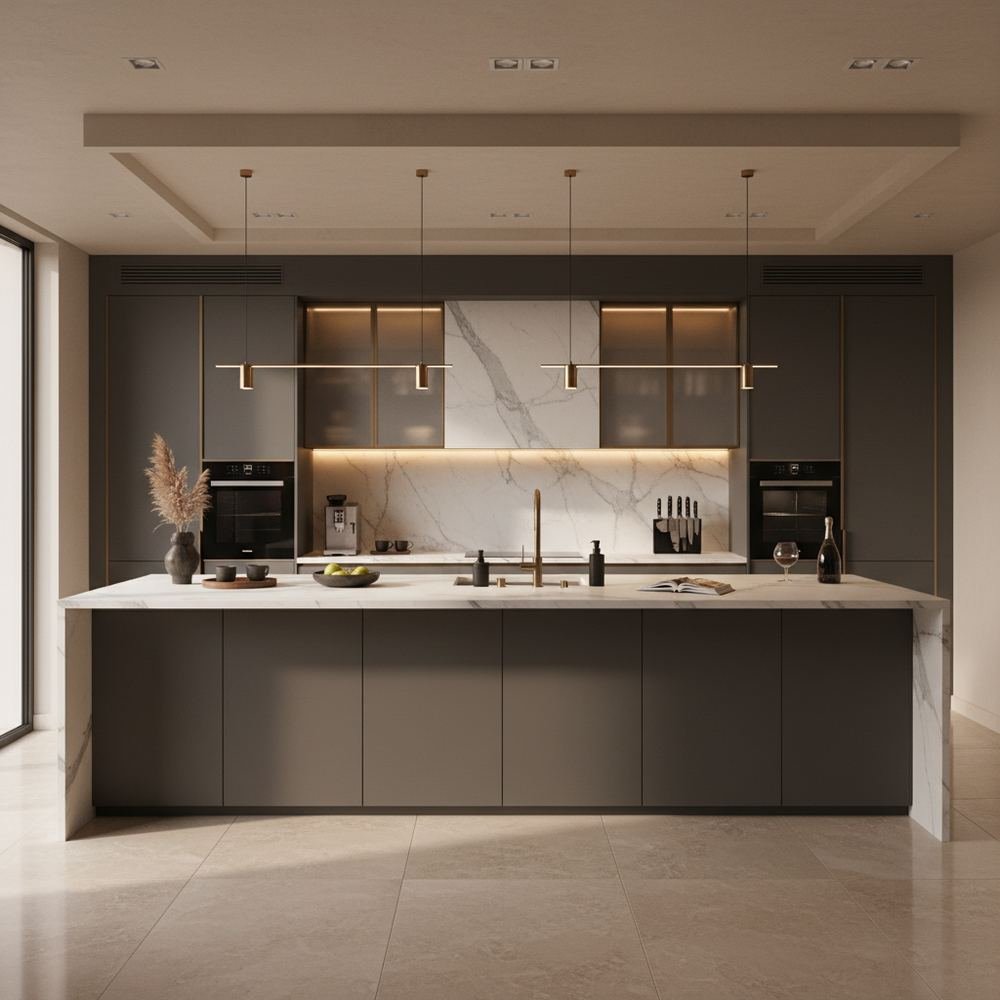
Marine Ply, MDF or Particle Board: Which Survives a Pakistani Kitchen
The board behind the shutter decides how long your kitchen lasts. It is also the easiest place for a quote to be quietly downgraded.
In a Pakistani kitchen the carcass board matters more than the finish on the front, because the carcass is what meets water, steam and monsoon humidity. Marine grade plywood handles moisture best, HDF and MDF are stable and smooth but vulnerable at cut edges, and particle board is the cheapest and the first to fail. The right answer is usually to vary the board by location rather than to use one everywhere.
What is actually different between these boards?
Plywood is thin wood veneers glued in cross directions. That cross grain is what makes it strong and resistant to bending. Marine grade plywood uses adhesives designed to hold up under prolonged damp, which is the property that matters here.
MDF is wood fibre compressed with resin into a dense, perfectly uniform sheet. It has no grain, so it machines beautifully and takes paint and lacquer better than plywood. Its weakness is water at the edges, where it swells and cannot recover.
HDF is the same idea at higher density. It is harder, holds a screw better and resists moisture better than standard MDF, but it is still a fibre board.
Particle board is wood chips bonded with resin. It is the cheapest and the weakest. It sags under load over a span and disintegrates once water gets in.
Which board survives near water?
Ranked by how they behave when moisture reaches them:
- Marine grade plywood. Handles repeated damp and dries out without delaminating. The right choice under the sink.
- Commercial plywood. Better than any fibre board, but the adhesive is not made for sustained wetting.
- HDF. Dense enough to resist brief contact, but a soaked edge is permanent damage.
- MDF. Swells visibly and irreversibly once water finds an unsealed edge.
- Particle board. Fails fastest and most completely.
The critical detail is that fibre boards rarely fail through the face. They fail at the edges, especially cut edges around sink cutouts and the bottom of the sink cabinet where a slow leak sits unnoticed.
Does Lahore humidity really make a difference?
Yes, and it works differently from a leak. Monsoon humidity is a slow cycle rather than an event. Boards absorb moisture from the air, expand slightly, then contract when the air dries.
Repeated over years, that cycle is what loosens edge banding, opens joints and makes doors that once closed perfectly start to catch. It is also why a kitchen that was flawless in its first winter can look tired by its third monsoon.
Plywood tolerates this cycling better because its cross grain construction resists movement in both directions. This is the practical reason it stays the default for kitchen carcasses in this climate.
Which board should go where?
Using one board throughout is either wasteful or risky. A sensible kitchen varies it.
- Under the sink: marine grade plywood, with the cut edges sealed. This cabinet takes more moisture than everything else combined.
- Base cabinets generally: plywood, because they carry load and sit closest to spills.
- Upper cabinets: plywood or HDF. They carry less weight and sit away from standing water, though they do meet steam and grease.
- Shutters and fronts: HDF or MDF are often better here, because they are flat, stable and take a high quality painted or lacquered finish that plywood cannot match.
- Shelves over a span: plywood, or a thicker section, because particle board and thin MDF sag.
- Back panels: thinner material is acceptable, but it should still be a grade that tolerates humidity.
What matters as much as the board itself?
Three things, all invisible in a photograph.
Edge banding. The band is what stops moisture reaching the core. Thin banding lifts in our humidity within a few years, and once it lifts the edge is exposed. Heavier banding costs more and is one of the highest value upgrades in a kitchen.
Edge sealing at cutouts. Every cut for a sink, a tap or a service pipe exposes raw core. If those cuts are not sealed, the best board in the world will still swell there.
Back panel and wall gap. A carcass pressed flat against a damp external wall will absorb moisture from behind, where nobody looks until a door stops closing.
How do you check what you are being quoted?
Board grade is one of the easiest things to downgrade quietly, because the customer sees only the shutter. Ask for the specification in writing and be specific:
- Which board is used for the carcass, and which for the shutters?
- What is used specifically under the sink?
- What thickness, and what thickness of edge banding?
- Are cut edges around the sink and services sealed?
- Is the quoted rate for the carcass and shutter together, or the shutter only?
A quote that answers all five can be compared honestly with another that does the same. A quote that only gives a total per running foot cannot be compared with anything.
Is the most expensive board always right?
No. Marine plywood everywhere, including on flat painted shutters, is money spent where it buys nothing, and it will give a worse painted finish than a properly prepared fibre board.
The better principle is to match the board to the risk at that position. Spend on the wet, loaded and buried places. Choose for finish quality where the board is dry and visible. That is how a kitchen ends up both durable and well finished rather than one or the other.
Building it properly
At Grains, boards, hinges and channels are imported and the whole kitchen is manufactured at our own facility on Raiwind Road, so the specification you agree is the specification that gets built. We put it in writing rather than behind a single rate, and our own teams install it. Measurement, 3D design and estimate cost nothing. Send your kitchen dimensions to WhatsApp +92 320 4443864, or browse the range on our kitchens page. The same board thinking applies to wardrobes and bathroom vanities, which face their own moisture problems.
Questions, answered.
Marine grade plywood is the best choice for the carcass, especially under the sink and for base cabinets, because it tolerates repeated damp and monsoon humidity cycling without delaminating. HDF or MDF often suit shutters better, because they are flat and stable and take a painted or lacquered finish that plywood cannot match.
MDF is suitable for shutters and dry upper areas, where its flatness gives a superior painted finish. It is a poor choice under the sink or anywhere water can reach a cut edge, because MDF swells irreversibly once moisture enters the core. If MDF is used, edge banding and edge sealing become critical.
Humidity is a slow cycle rather than a single event. Boards absorb moisture from the air, expand slightly, then contract as the air dries. Repeated over years this loosens edge banding, opens joints and makes doors start to catch. Failures usually begin at edges, not faces, particularly at unsealed cut edges.
Both are wood fibre compressed with resin into a uniform sheet with no grain. HDF is made at higher density, so it is harder, holds screws better and resists moisture better than standard MDF. Both remain fibre boards and both are vulnerable at cut edges compared with plywood.
Ask five specific questions in writing: which board for the carcass, which for the shutters, what is used under the sink, what thickness of board and edge banding, and whether cut edges at the sink and services are sealed. Also confirm whether the rate covers carcass and shutter together or the shutter alone.
No. Using one board everywhere is either wasteful or risky. Match the board to the risk at each position: marine plywood under the sink and in base cabinets, plywood or HDF above, and HDF or MDF on shutters where a flat stable surface gives a better finish.
Planning this for your own home?
We measure your space in Lahore free of charge, show you a 3D design before anything is cut, then manufacture and install it with our own teams.